
A recent trademark judgment in China has become far more than a dispute over two similar-looking flowers.
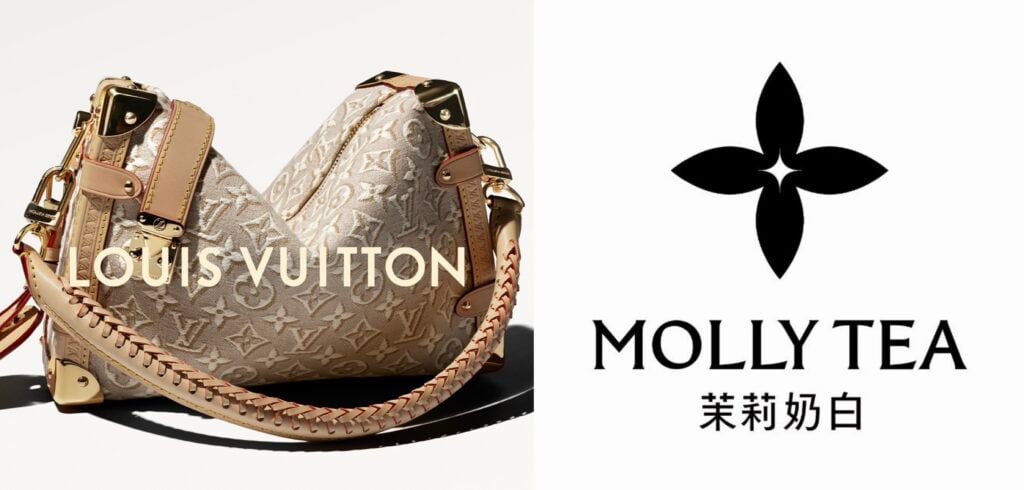
The Suzhou Intermediate People’s Court in Jiangsu province ruled at first instance that Chinese tea chain Molly Tea, known locally as Moli Naibai, infringed Louis Vuitton’s exclusive rights to a registered four-petal floral trademark. The court ordered the beverage company to pay RMB 10.3 million, approximately $1.4 million, in damages.
The judgment has not yet taken effect. The case remains within the appeal period, and Molly Tea reportedly plans to challenge the ruling.
Online, however, the dispute has already produced a verdict of a different kind. By July 10, a Weibo hashtag related to Louis Vuitton’s lawsuit and the RMB 10.3 million award had generated around 400 million views.
The conversation quickly moved beyond whether the two marks were visually similar. Instead, another question emerged: how can a French luxury house claim exclusive rights over a floral form that many Chinese consumers associate with traditional decorative vocabularies?
That tension—between what trademark law protects and what the public perceives as shared cultural language—has turned a commercial dispute into a much larger conversation about aesthetic authority in China.
Winning in Court, Losing the Public Narrative
From a legal perspective, Louis Vuitton’s first-instance victory is relatively straightforward.
According to Liu Jiadi, a partner at Chinese law firm JunHe, the public’s intuitive understanding of the dispute differs from the framework applied under trademark law.
The court is not being asked to determine whether four-petal motifs have historically appeared in Chinese decorative traditions. Rather, it must assess Louis Vuitton’s registered trademark rights and whether Molly Tea’s use falls within their protected scope.
Louis Vuitton has secured registrations in China covering products in Class 30, including iced tea and tea-based beverages, as well as services in Class 43, which includes food and beverage services, Liu explained.
Molly Tea used a highly similar floral graphic across packaging, storefront signage, promotional materials, and other commercial touchpoints. Because these applications can indicate commercial origin to consumers, they may qualify as trademark use.
Liu also noted that Molly Tea had previously attempted to register a similar graphic-and-word combination in Class 30 but was unsuccessful—a history that may have influenced the court’s assessment of the company’s conduct.
The legal issue, then, is not whether motifs resembling the baoxiang flower, persimmon-calyx pattern, or crabapple blossom existed before Louis Vuitton. Traditional floral motifs encompass countless variations in proportion, curvature, color, and composition. Trademark protection applies to a specific visual expression that has been registered and developed as an identifier of commercial origin.
Public discussion has followed a different logic.
On Chinese social media, many users were not asking only whether Molly Tea’s logo resembled Louis Vuitton’s. They were asking why a visual form associated in their minds with traditional ornamentation could be controlled by a Western luxury company.
That helps explain why Molly Tea gained public sympathy despite losing the first-instance case.
Chinese state broadcaster CNR reported increased orders and longer queues at some Molly Tea stores after the dispute gained attention. On July 7, the Weibo hashtag “Molly Tea Lost the Lawsuit but Won the People’s Support” topped the platform’s trending list, drawing approximately 30 million views. Some users posted photographs of their purchases as expressions of solidarity.
The reaction points to something larger than disagreement over a trademark.
Consumers are increasingly questioning who gets to define what looks sophisticated or luxurious, who has the institutional power to convert visual languages into protected brand assets, and how a company’s position in the global brand hierarchy shapes perceptions of that ownership.
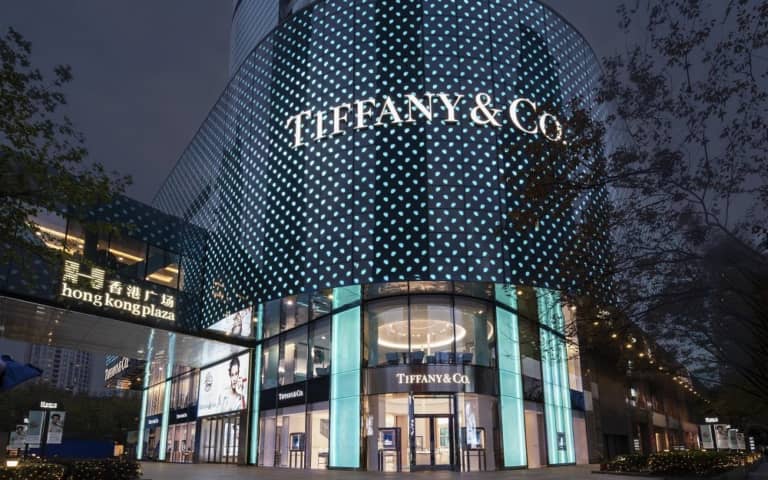
Some users extended the comparison to visual elements associated with Givenchy, Goyard, Tiffany & Co., and Van Cleef & Arpels, placing them alongside traditional Chinese patterns. The comparisons were not legal arguments so much as expressions of renewed interest in China’s own aesthetic agency.
The most revealing aspect of the controversy is therefore not that the public misunderstands trademark law. It is that legal and cultural legitimacy are operating on different planes.
The court sees registered trademarks, visual similarity, and commercial use. The public sees cultural memory, aesthetic authority, and an imbalance in who gets to claim ownership.
From Mamianqun to “Who Owns This Flower?”
Chinese consumers’ engagement with traditional culture has changed considerably over the past several years. What began as an aesthetic revival around Hanfu, New Chinese Style, and traditional motifs has increasingly expanded into questions of origin, attribution, and commercial ownership.
The 2022 controversy surrounding Dior’s mamianqun-inspired skirt marked an important turning point.
Chinese internet users and Hanfu enthusiasts argued that the construction of a Dior skirt closely resembled the mamianqun, a traditional Chinese pleated garment whose name literally translates as “horse-face skirt.” Dior described the design as an iconic house silhouette, prompting accusations of cultural appropriation and protests by Chinese students in cities including Paris.
The debate was not simply about resemblance. Consumers wanted the cultural source to be acknowledged.
The controversy also introduced the mamianqun to a much wider audience. Combined with the broader rise of Hanfu and New Chinese Style, the garment subsequently entered mainstream fashion consumption. According to the 2024 Douyin E-commerce Women’s Consumption Trends Report, orders for mamianqun skirts rose 841 percent year on year in 2023, while Hanfu orders increased 336 percent.
If the Dior controversy centered on acknowledgment, the Louis Vuitton–Molly Tea dispute goes a step further toward ownership.
Consumers are now examining how cultural symbols are extracted, interpreted, registered, and converted into commercial assets—and how those assets can subsequently be enforced against others.
The historical reality, however, is more complicated than a simple East-versus-West narrative.
Four-petal floral structures can emerge from natural forms or geometric construction, and comparable motifs have appeared across China, Central Asia, Western Asia, and other cultural contexts. Decorative languages have always traveled through trade, craftsmanship, migration, and cultural exchange.
Traditional motifs are therefore rarely static objects with a single uncontested origin.
Precisely because these visual languages are fluid, tension emerges when modern commercial systems turn a particular expression into an exclusive asset.
The controversy also reveals something about Chinese consumers’ changing relationship with luxury.
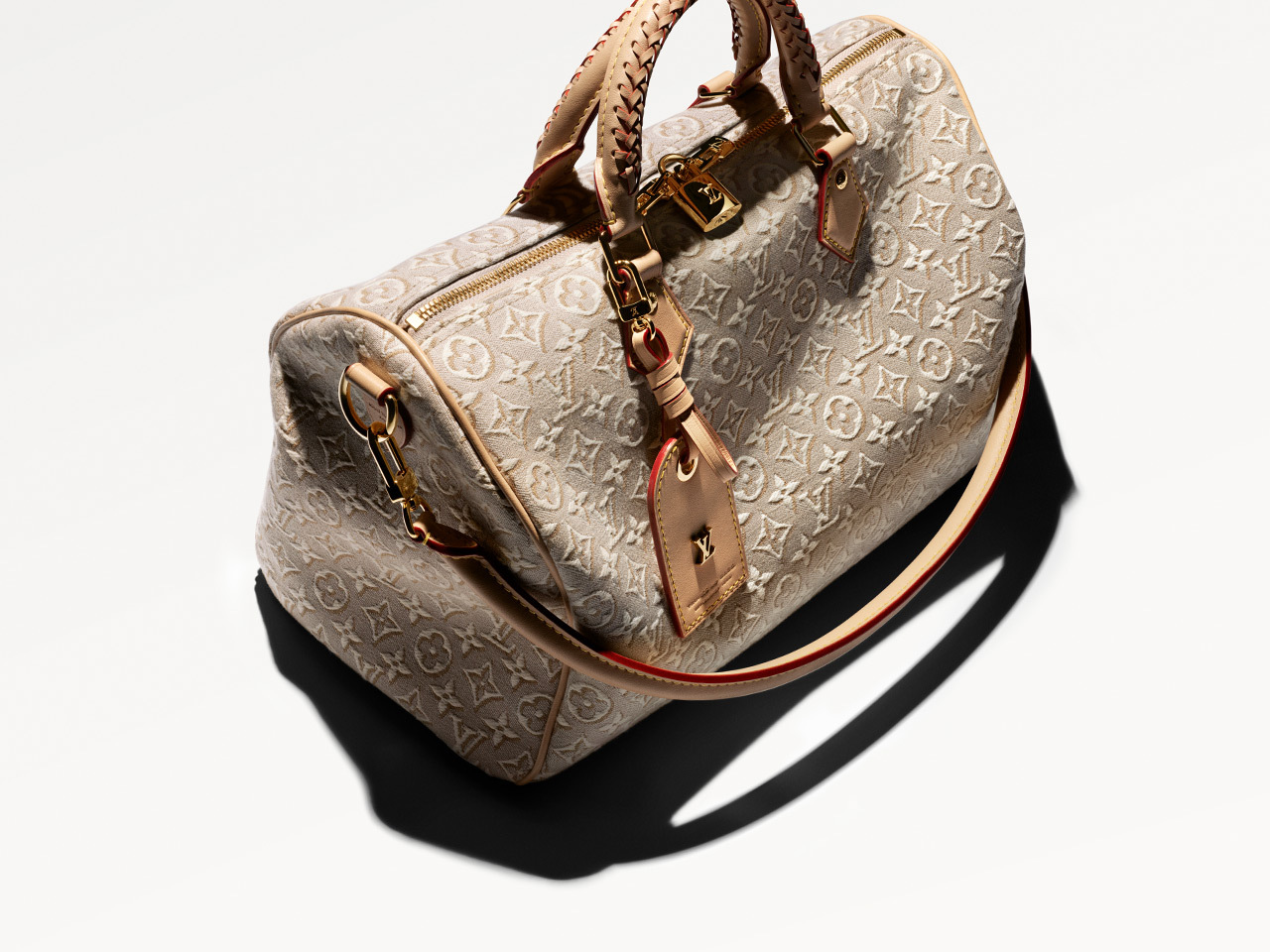
Louis Vuitton’s Monogram has long been communicated through heritage, travel culture, craftsmanship, and status. This dispute exposes another layer of that system: trademark portfolios, legal enforcement, and the infrastructure required to protect global brand assets.
Luxury brands remain desirable. But their authority to define aesthetic meaning is increasingly open to negotiation.
When Fluid Culture Becomes Exclusive IP
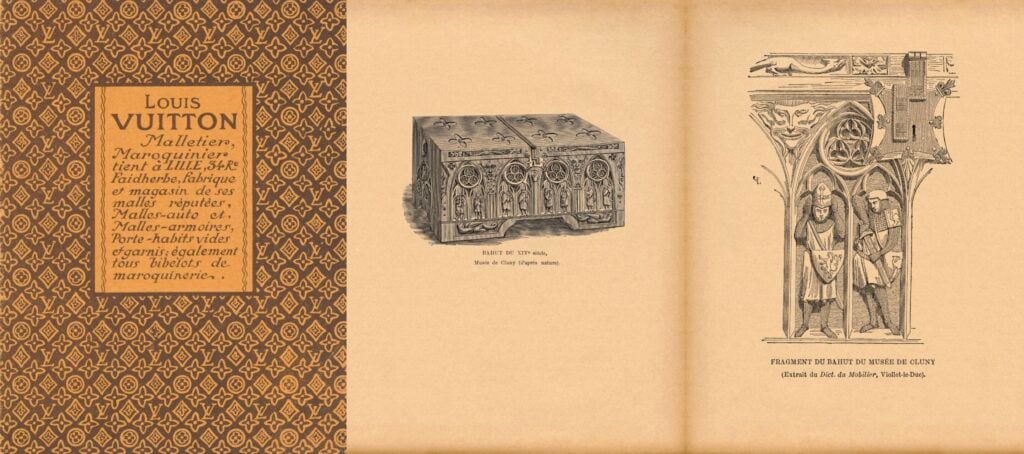
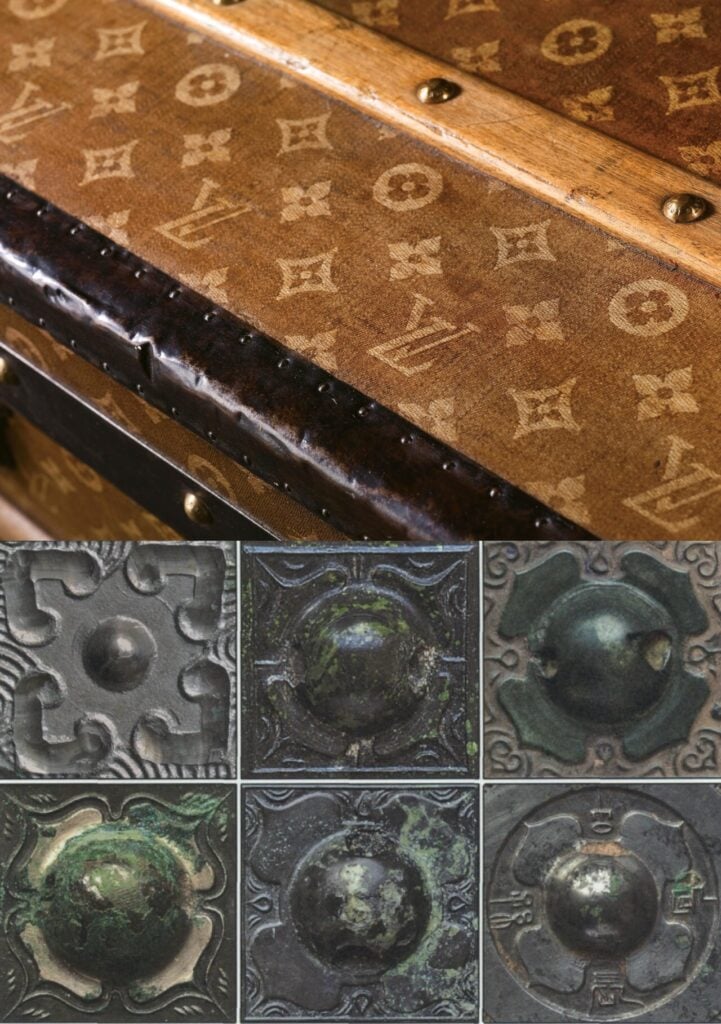
Louis Vuitton’s own Monogram illustrates the complexity.
According to LVMH, the design was originally conceived partly to protect the house’s creations and drew visual inspiration from Neo-Gothic ornament and Japonism—the 19th-century European fascination with Japanese art and design.
In other words, one of luxury’s most recognizable visual systems emerged within a history of cross-cultural influence.
That does not weaken Louis Vuitton’s right to protect its registered trademarks. It does, however, sharpen the question raised by the Molly Tea controversy: how does a visual language that moves between cultures eventually become an exclusive commercial asset?
Trademark law and cultural history answer that question differently.
The law protects a specific registered graphic and its function as an identifier of commercial origin. Cultural memory is less easily bounded. What may appear to a company as a distinctive proprietary design can simultaneously remind consumers of motifs they regard as part of a much broader visual inheritance.
That distinction matters for brands on both sides of the dispute.
For Chinese companies, the case is a warning against treating “Eastern aesthetics,” “traditional motifs,” or a generalized “sense of luxury” as an open pool of visual material.
As packaging, retail environments, and social-media imagery become increasingly important brand assets, companies need original visual systems, documented design processes, and coherent intellectual-property strategies. Traditional culture can provide inspiration, but it cannot substitute for original design.
Liu also noted that companies facing findings of infringement need to review their use of disputed materials carefully. Public sympathy can be temporary; continued infringement could affect future partnerships, commercial expansion, and long-term brand reputation.
For international luxury brands, the lesson is different.
Intellectual-property enforcement is a legitimate part of protecting brand value. But in China, enforcement can also become an act of cultural communication—particularly when the visual territory being protected overlaps with consumers’ memories of traditional design.
Precision therefore matters. A company is protecting a specific registered design and system of commercial identification, not an entire category of flowers, Eastern ornament, or traditional culture.
Louis Vuitton’s trademark activity in China also extends beyond this civil dispute. According to a notice published by China’s courts, the company is involved in a separate trademark administrative case against the China National Intellectual Property Administration, scheduled to be heard by the Beijing Intellectual Property Court on July 16.
The case is unrelated to Molly Tea, but it illustrates how registration, confirmation, and enforcement form part of the long-term management of global brand assets.
Beyond the Ownership of a Flower
There is no simple answer to who “owns” a four-petal flower.
Trademark law addresses specific commercial rights. Culture operates through a much wider field of memory, exchange, and interpretation.
The Louis Vuitton–Molly Tea dispute exposes the friction between the two. A visual language can circulate across cultures for centuries and still, in a particular configuration, become legally protectable as a modern brand asset.
For companies operating at the intersection of commerce and culture, that distinction is becoming increasingly important.
A brand may own the trademark. It does not automatically own the cultural meaning attached to it.