
A weekly snapshot of the China consumer market, tracking brand partnerships, retail expansion, and investment activity.
This week’s developments highlight a China consumer market defined by divergence. Luxury spending is showing signs of recovery even as global demand softens, international brands are rethinking their physical and digital footprints, and domestic players are making increasingly ambitious bets on global expansion and new consumer segments. Together, these moves reveal a market where growth remains available—but only for brands willing to adapt.
Market Mood: Cautious Optimism and Shifting Channels
Official data from the National Bureau of Statistics for April indicates a tepid overall retail environment, with total retail sales of consumer goods rising just 0.2% year-on-year to RMB 3.72 trillion. However, the beauty sector continues to outperform, with cosmetics sales climbing 4.7% to RMB 32.6 billion. This divergence is echoed in retail formats, where convenience stores and supermarkets gain ground while branded specialty stores contract. This backdrop of cautious consumer sentiment makes the strong performance of certain luxury players all the more notable.
Ralph Lauren reported a landmark fiscal year, with revenue surpassing $8 billion for the first time, driven by a 51% surge in China during the fourth quarter, attributed to Lunar New Year spending. Similarly, Richemont’s fiscal 2026 sales rose 11% to €22.4 billion, with its jewelry maisons up 14%. The Asia-Pacific region remained its largest market, and while China grew only 3% for the full year, it has now posted three consecutive quarters of recovery, giving the group confidence to optimize its retail network and upgrade flagship store experiences. Chow Tai Fook also signaled a strong rebound, forecasting a 45-55% net profit jump for fiscal 2026, with mainland same-store sales swinging from a 30.8% decline to a 0.2% gain, while Hong Kong and Macau saw a dramatic 40.1% increase.
The most striking counter-trend came from the Swiss watch industry. Despite a 16.6% global export decline in April—dragged down by a 56.4% collapse in the U.S. market—exports to mainland China rose 17.1% to CHF 154 million. Hong Kong followed with a 13.5% increase. This decoupling suggests that while Western markets cool, Chinese appetite for high-end timepieces remains resilient, even as sales of watches above CHF 3,000 fell globally.
The Great Retail Reshuffle: Flagship Exits, New Entrants, and a Key Promotion
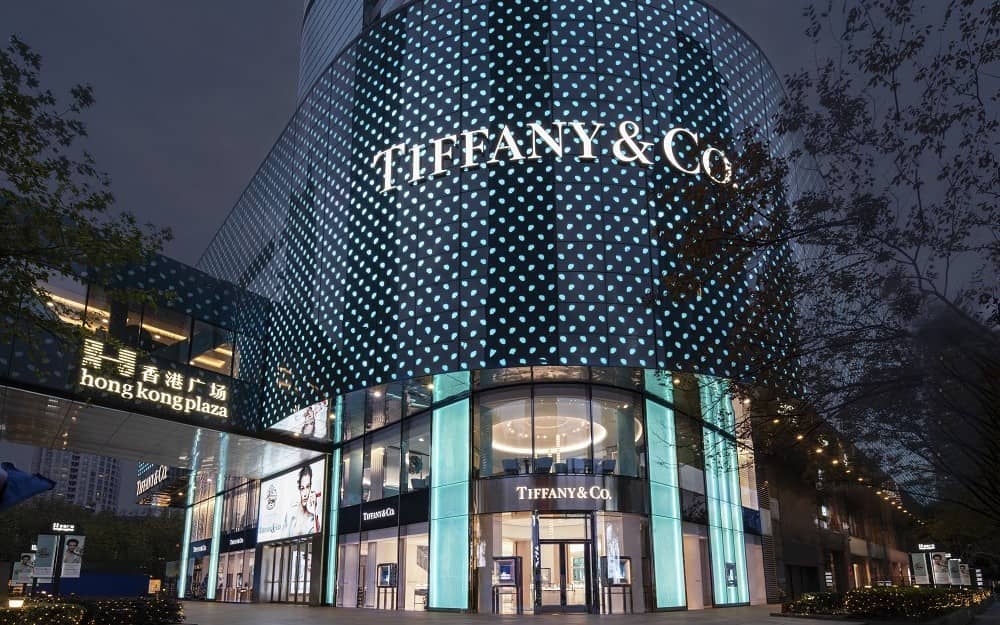
The physical retail landscape is undergoing a significant transformation, best illustrated by a game of musical chairs at prime locations. In Shanghai’s Hong Kong Plaza, Massimo Dutti has taken over the former Tiffany & Co. flagship—once one of the jeweler’s largest in Asia at over 1,100 square meters—to open a 900-square-meter Asian flagship. The move is seen as emblematic of a broader trend: luxury brands are scaling back monumental stores while “affordable luxury” brands with more restrained pricing move in to capture the mass-affluent consumer. This pattern is repeating in Hong Kong’s Causeway Bay, where SKIMS will open its first standalone Chinese store in a space previously occupied by Tiffany.
Amid this reshuffle, Swire Properties has promoted Calvin See, the general manager of HKRI Taikoo Hui, to oversee its mainland China retail operations—a move widely attributed to the success of the “The Louis” pop-ups at the mall. Meanwhile, Thai fragrance brand Pañpuri is opening its first mainland China store at the same property, positioning itself next to Aesop. Further south, Hong Kong’s retail revival continues to solidify, with April sales up 8.6% year-on-year, led by a 19.8% jump in jewellery and watches.
Digital and Physical Brand Building: Ambassadors, Archives, and Platforms
Brands are sharpening their tools for consumer engagement, both online and offline. The Armani Group has restructured its social media presence in China, creating separate accounts for Giorgio Armani and Emporio Armani to delineate classic elegance from youthful, urban energy, while Armani Exchange focuses its efforts on Douyin. This mirrors the brand’s global strategy and acknowledges the distinct audience segments its three lines have cultivated over years of development.
In a move that bridges heritage and hype, Birkenstock opened a five-day “House of Boston” exhibition in a historic 1939 building on Shanghai’s Changle Road to celebrate the 50th anniversary of its iconic clog. The space featured archival products, the premium 1774 collection, and DIY workshops, reinforcing the shoe’s evolution from functional footwear to a global cultural symbol.

On the sports front, Li-Ning has made a decade-long strategic bet by signing basketball superstar Stephen Curry. The partnership will span basketball, golf, and sportswear, with plans to expand the Curry Brand across China and the U.S. The announcement caused a brief spike in Li-Ning’s share price, though it pared gains to close down 0.79%. Industry observers view this as a critical step in the brand’s globalization push, aiming to transition from a Chinese powerhouse to a global sportswear contender.
Strategic Bets: New Markets, World Cup Rights, and Cross-Border Expansion
Several companies are making significant strategic pivots or exploring new frontiers. South Korea’s largest convenience store chain, CU, has officially signaled its entry into China by launching a social media account and hinting at physical store preparations. With 18,600 stores in Korea, CU faces the challenge of competing with established Japanese chains and solving fresh food supply chain issues in a domestic market where convenience stores are the fastest-growing retail format but face declining foot traffic and basket sizes.
In the digital arena, lifestyle platform Xiaohongshu has secured broadcasting rights for the 2026 FIFA World Cup, joining state broadcaster CCTV and streamer Migu. The platform, which has been steadily building its sports content since 2022, will stream all 104 matches for free. The move reflects Xiaohongshu’s effort to broaden its audience beyond its core user base and compete more directly for mainstream attention within the China consumer market.
Finally, cross-border M&A speculation has resurfaced. Chinese e-commerce giant JD.com is reportedly considering a £2 billion bid for The Very Group, a UK online retailer specializing in home appliances, baby products, and “buy now, pay later” services. Neither company has commented, but the report marks JD.com’s continued interest in the British market after previous failed attempts to acquire Currys and Argos.
On the domestic beauty front, Yatsen Group continues its turnaround. The company posted a 22.5% revenue increase in the first quarter of 2026 to RMB 1.02 billion, marking its sixth consecutive quarter of growth. Its skincare business, led by Galénic and Eve Lom, jumped 58.5% to now account for 56.2% of total revenue. Separately, Yatsen completed the first tranche of a $120 million convertible note placement, with participation from founder Huang Jinfeng, CITIC Capital, and Hillhouse Capital, earmarked for R&D, supply chain integration, and overseas expansion. The company achieved its first-ever annual non-GAAP net profit in 2025.
Conclusion
This week’s developments reinforce the idea that the China consumer market is becoming increasingly segmented and selective. Luxury and mass retail are moving in different directions, physical store strategies are being rapidly redrawn, and digital platforms are investing heavily to reach new audiences. From Li-Ning’s global ambitions to Xiaohongshu’s World Cup bet, success increasingly depends on strategic focus, differentiated positioning, and the ability to capture the next generation of consumers.