
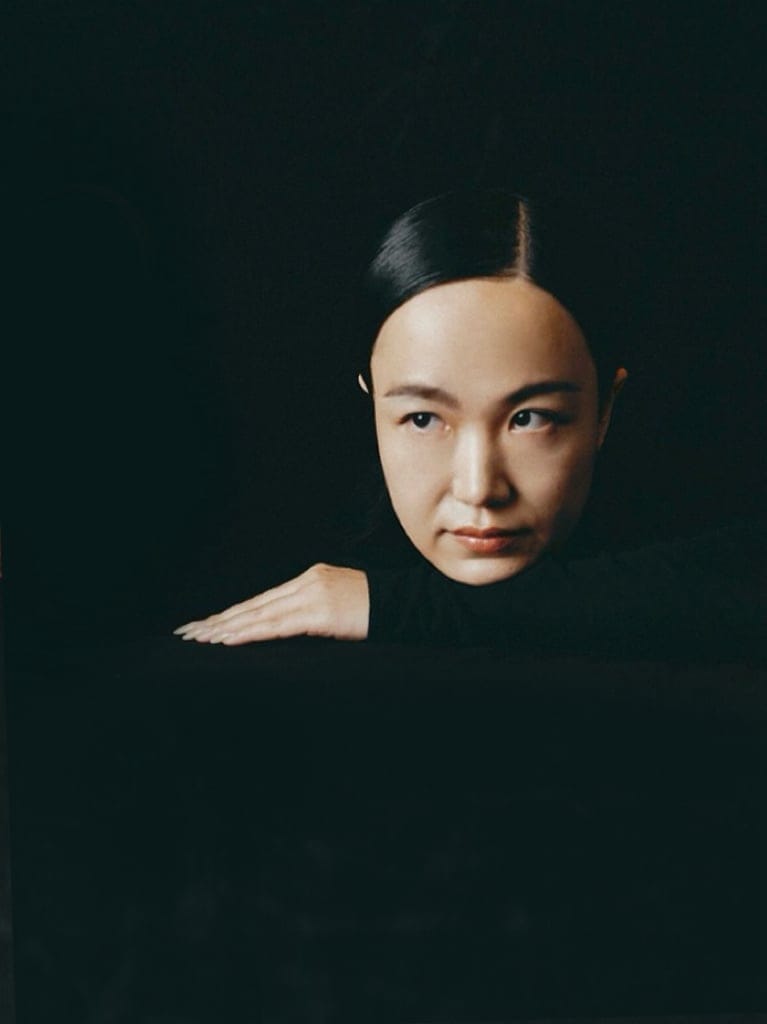
At Fashion Asia Hong Kong, the Shanghai-based designer Zixin Zhong reveals how Art Deco structure, Chinese restraint, and ritual thinking shape a globally resonant brand.
In the 1920s and 1930s, Shanghai emerged as one of the world’s most distinctive Art Deco capitals. Along the Bund and through the former French Concession, geometric façades rose in stepped silhouettes, merging Western modernism with Chinese craftsmanship. Imported form did not remain foreign for long. It was absorbed, translated, and made local.
Nearly a century later, that architectural memory continues to shape the city’s visual language.
At Fashion Asia Hong Kong — where the city positions itself as a bridge between Asian designers and global audiences — Art Deco felt like an apt metaphor. Among the ten Asian designers spotlighted this year was Shanghai-based designer Zixin Zhong, founder of the label Zhong Zixin.
Her inspirations are unmistakably international — from German expressionist cinema to British crime fiction and American fashion icons. Yet what emerges from these references is not imitation, but distillation.
If Art Deco provides the structural grammar of her work, what Zhong articulates through it is something more specific: an elegance shaped by Chinese sensibility.
“At the core of my work,” Zhong said, “is an elegance rooted in the East.”
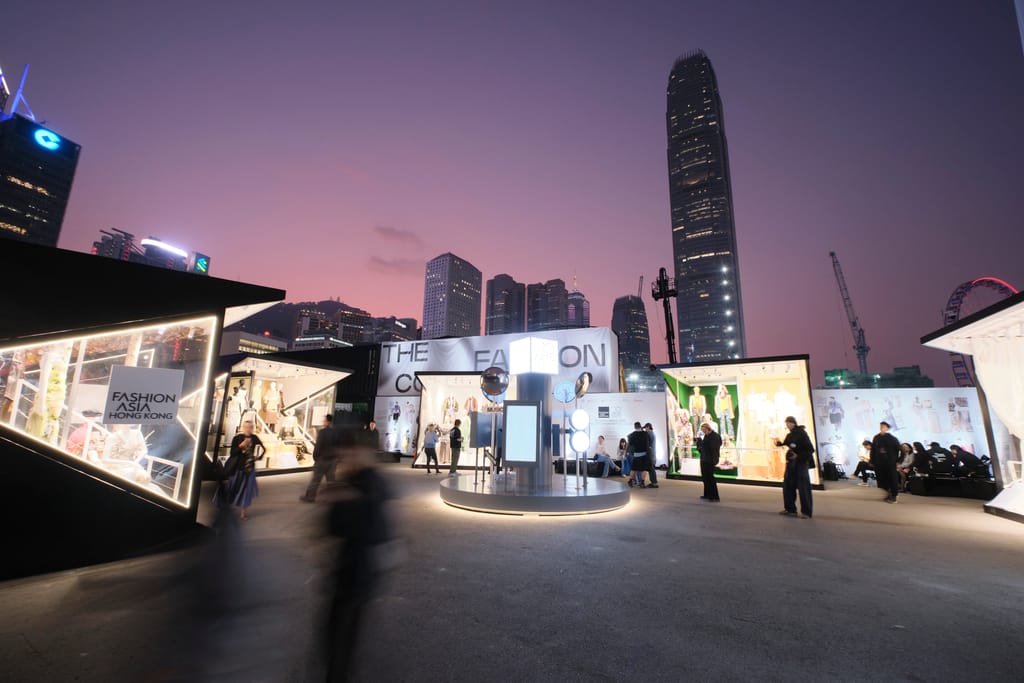
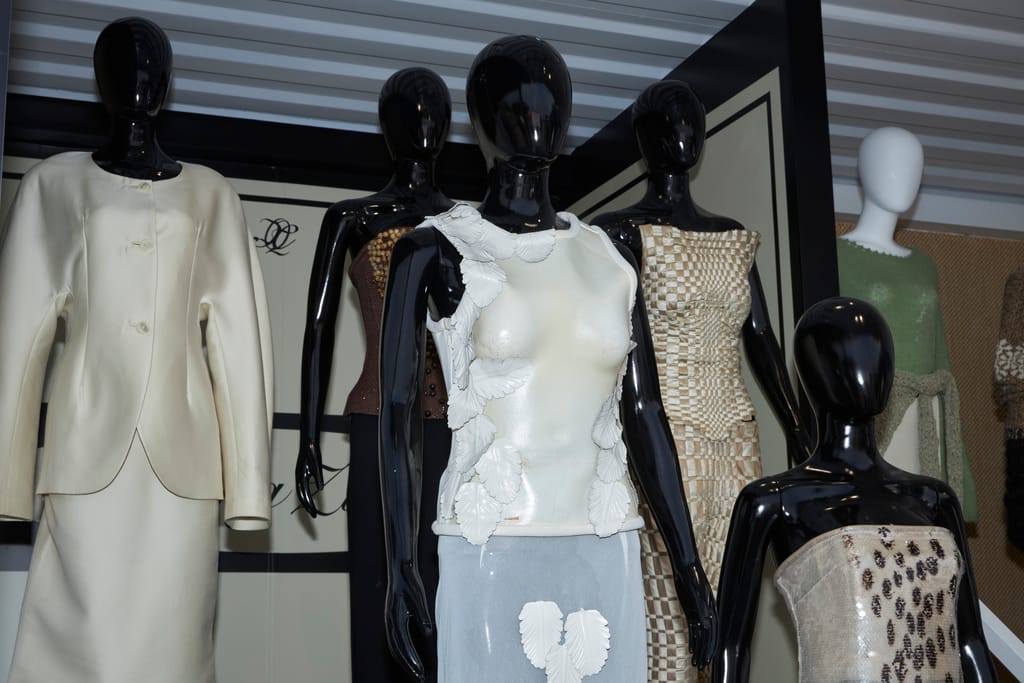
Mapping the Archive: Structure, Translation, and Interior Worlds
Since launching her label in 2021 after graduating from Central Saint Martins, Zhong has built an archive defined less by seasonal shifts than by recurring architectural logic.
Art Deco serves as her structural backbone. In early collections — including one inspired by Fritz Lang’s Metropolis — geometry functioned not as embellishment but as discipline. The female body was framed architecturally, curves negotiated through line and proportion rather than excess. Structure, not ornament, became the anchor.
Around this backbone, Zhong introduces women who exist at cultural thresholds. Anna May Wong, the first Chinese Hollywood film star, appears not as nostalgia but as translation — a figure navigating visibility across borders. Agatha Christie introduces psychological duality: tenderness and calculation coexisting within a single silhouette. Diana Vreeland’s “Garden in Hell” reframes the salon as theatre, positioning the woman as curator of her own interior world.
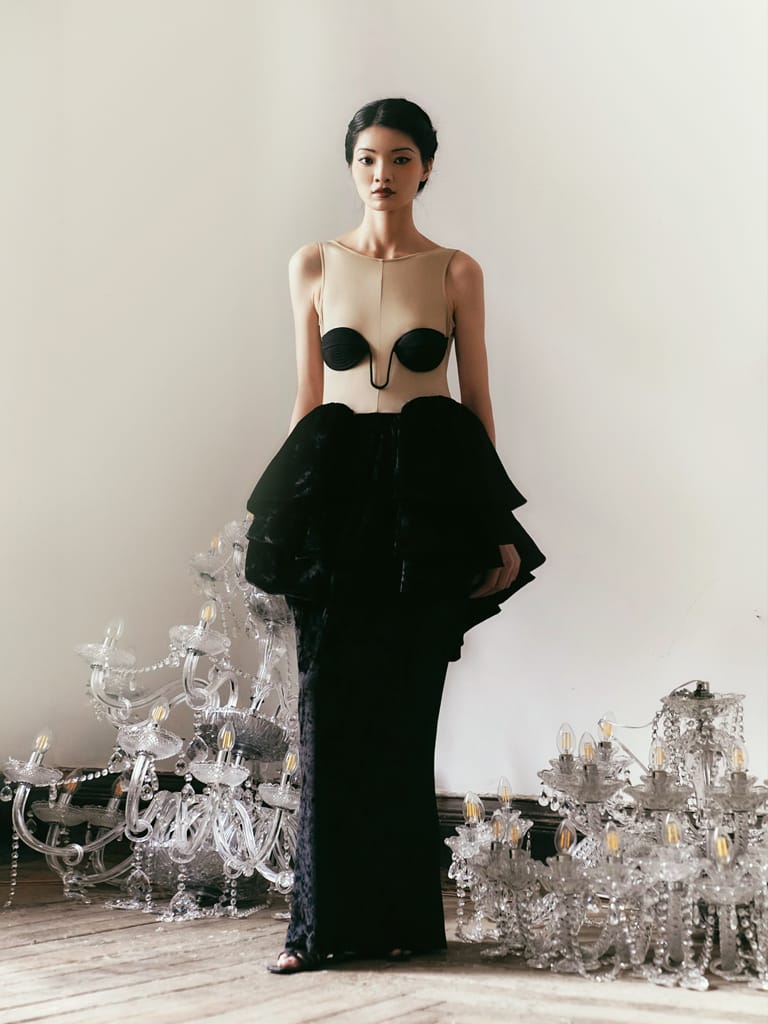
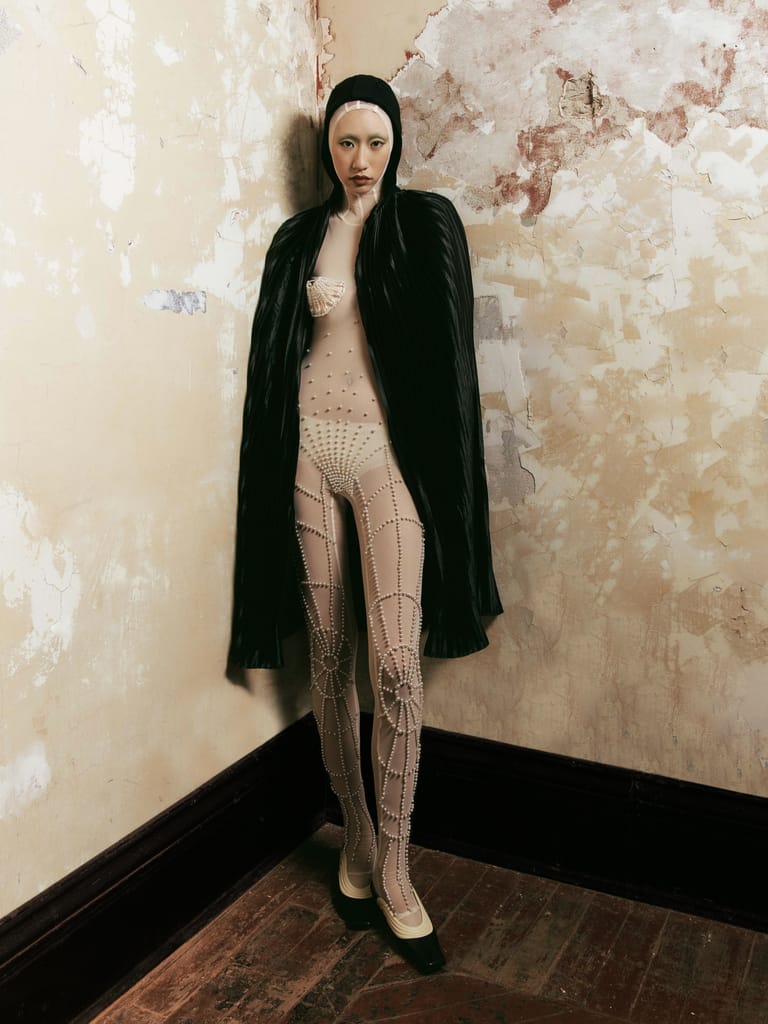
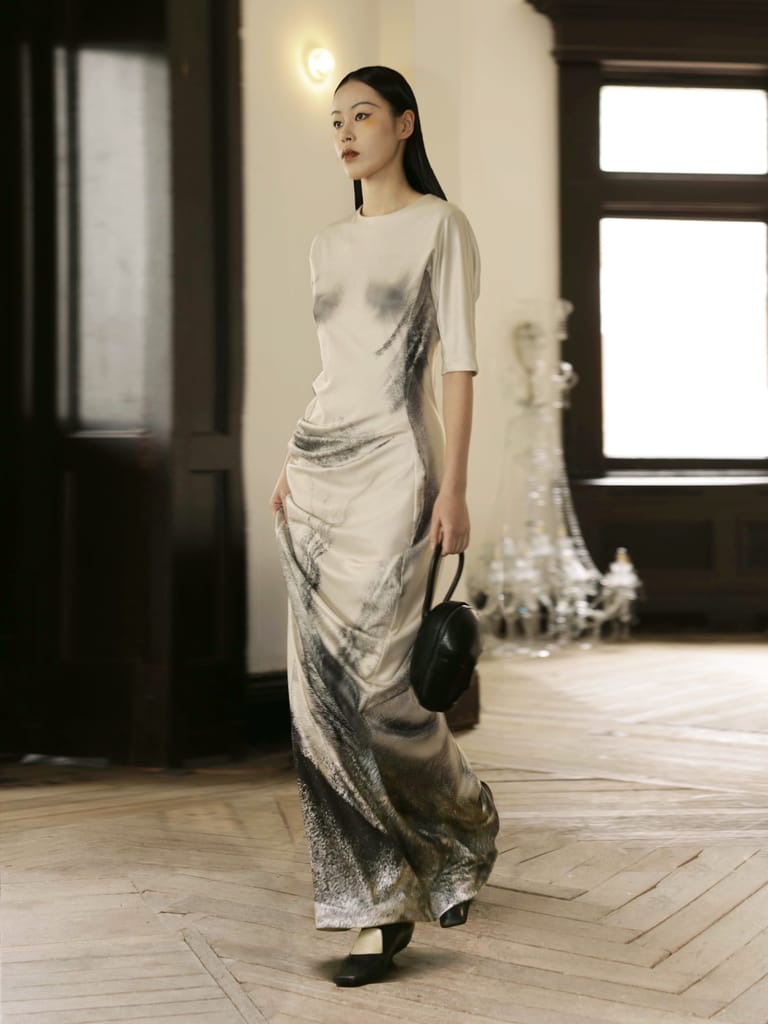
The references are unmistakably international. Yet Zhong’s treatment remains measured. Narrative becomes spatial rather than theatrical.
Her archive reads less like a sequence of collections and more like the construction of an interior architecture — one inhabited by women who command space without spectacle.
Chinese Sensibility in Contemporary Fashion Design
For Zhong, elegance is not a stylistic gesture; it is a way of living.
Growing up in southern China in a family connected to furniture, she developed an early sensitivity to atmosphere. Furniture decorates a room; clothing decorates the body. Both participate in shaping space.
“It’s not only when you go outside that you express yourself,” she said. “Even when you’re alone, you can dress for yourself.”
This interior orientation is evident in collections such as Woman on Lounge, where traditional skincare rituals and domestic tools were translated into silhouette and texture. Beaded curtains, woven mats, and South Pacific fabric references formed a nostalgic yet composed wardrobe. The home was not backdrop, but narrative setting — intimate, humid, quietly theatrical.
This domestic framing also informs her understanding of sensuality. Reflecting on design school debates about sexiness, she offered the qipao as a counterpoint to overt exposure.
“It doesn’t have to be obvious,” she said. “It can be understated — and that makes it more interesting.”
In her tailoring, curves are suggested rather than announced. Structure frames the body without exaggeration. What emerges is a distinctly Chinese language of restraint — one that favors suggestion over spectacle.
Craft, Memory, and the Circulation of Objects
Zhong’s material choices extend this architectural logic.
One recent collection incorporated glass grape ornaments once common in Chinese homes during the 1980s and 1990s. Produced during the so-called “export-creation” era, these decorative objects were made locally for overseas markets before circulating back into China as nostalgic artifacts. Zhong sourced them from second-hand markets, dismantled them, and reassembled them into sculptural elements.
The objects themselves embodied East–West exchange — crafted in China, consumed abroad, then reabsorbed as memory. By transforming them, she completed another cycle.
Her approach to intangible heritage follows similar reasoning. Rather than monumentalizing traditional craft, she integrates it into daily life — bamboo weaving reduced to a button, a detail, an accessory.
For Zhong, craft must feel lived-in rather than institutional.
“Craft often feels distant because people see it as something large, ceremonial, or untouchable,” she said. “If it becomes smaller — something you can wear, carry, or use every day — it’s easier for it to enter people’s lives.”
Refinement, in this context, is not branding. It is proximity.
Beyond Ready-to-Wear: Ritual, Permanence, and Strategic Restraint
As her visibility grows — with international runway presentations and prominent editorials — Zhong remains measured about scale.
“We don’t need so many clothes,” she said.
In an industry driven by acceleration, the statement feels pointed. Production volume alone does not create cultural depth. Zhong reframes her role not as a producer of endless collections, but as a curator of meaning.
“I see my role as discovering and collecting beauty” — Zixin Zhong
Her recent collection Bacchus signals this shift. Drawing on Caravaggio’s wine deity, the collection merged mythological imagery with Art Deco patterning. Cups and glasses informed sculptural silhouettes; grapes and vines layered the garments with symbolic density. Childhood memories of summer winemaking were abstracted into mosaic fragmentation and reconstruction.
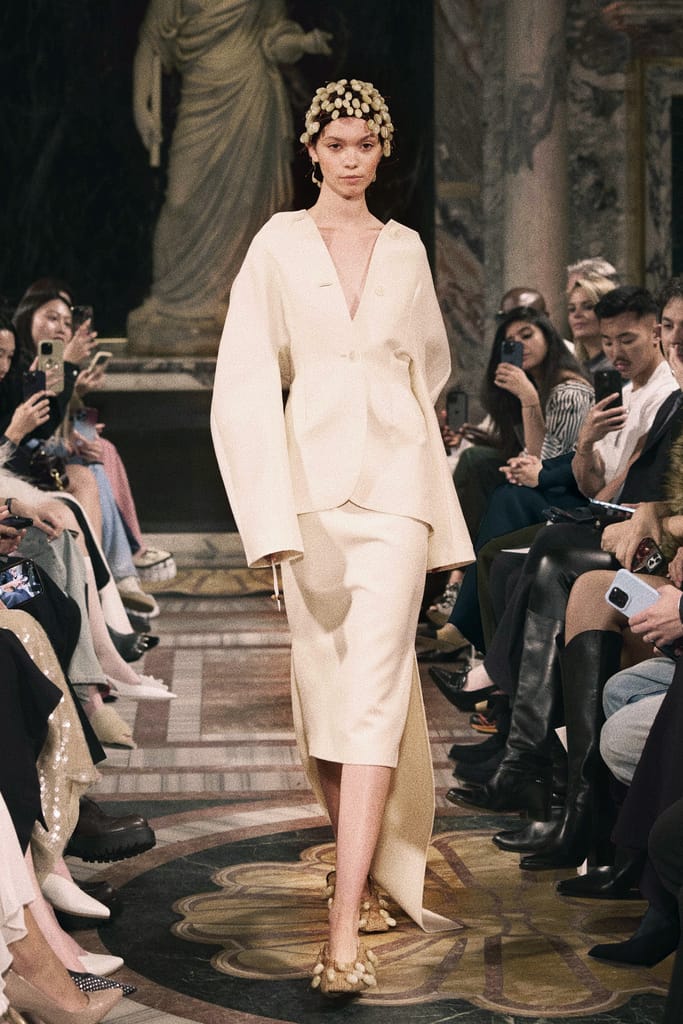
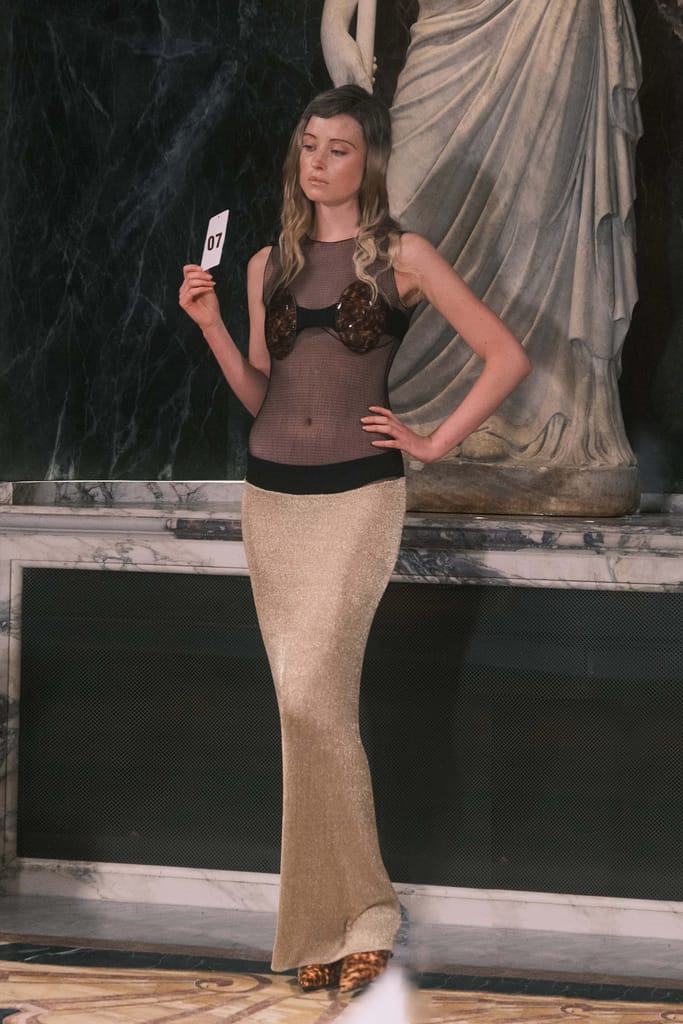
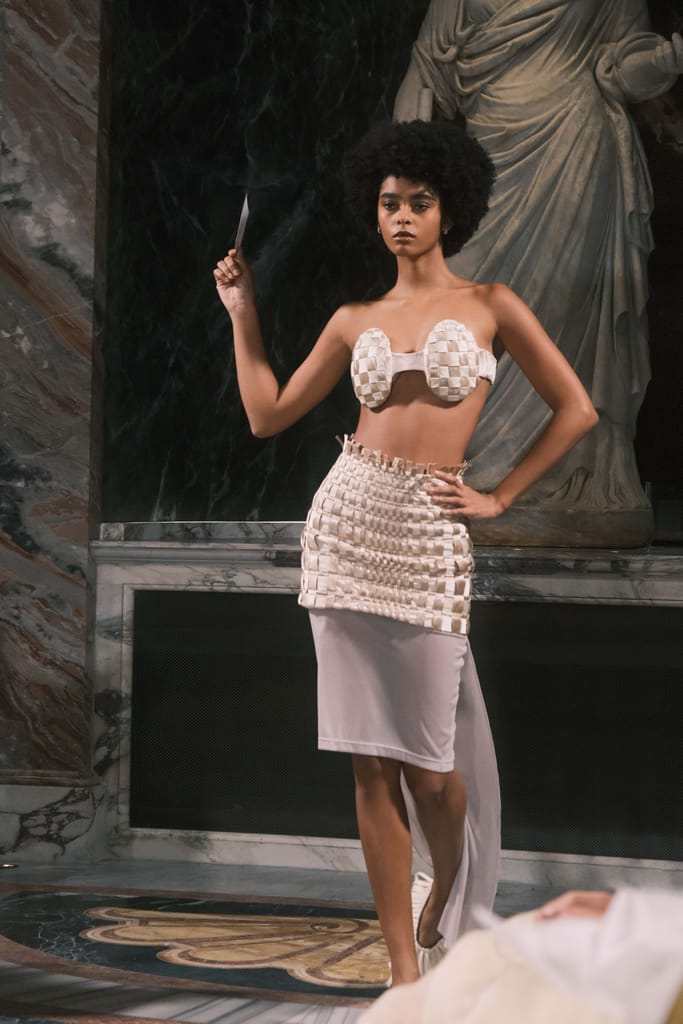
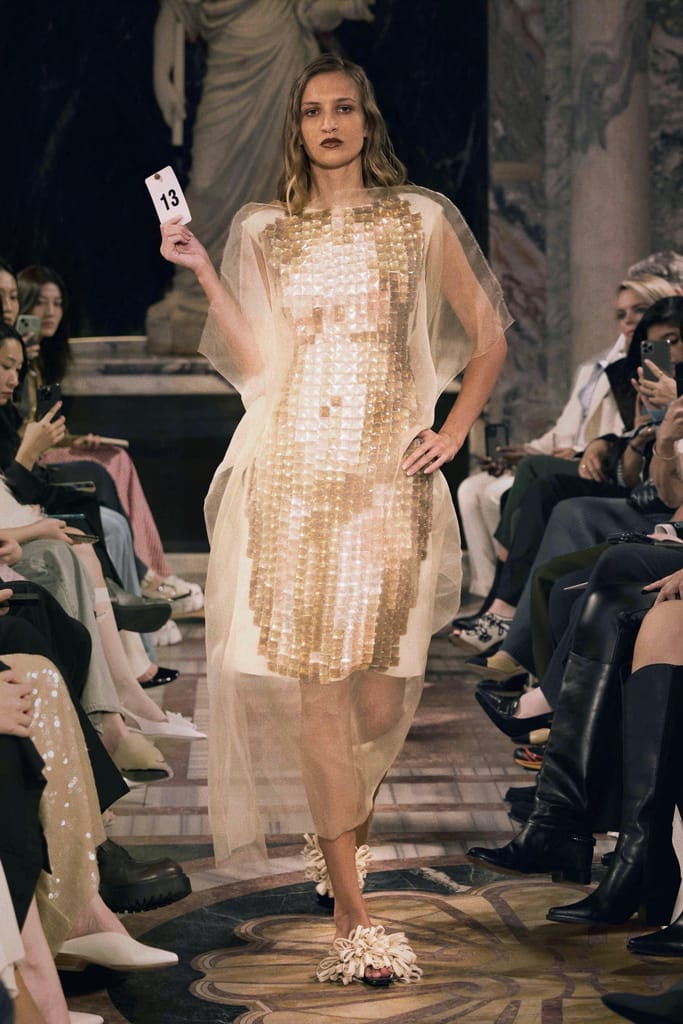
The result was less about daywear than atmosphere — a wardrobe oriented toward occasion rather than routine.
Looking ahead, Zhong is increasingly drawn to garments tied to life milestones — weddings, ceremonies, commemorative occasions. Pieces that are limited, personal, and designed to endure.
If earlier collections constructed rooms inhabited by iconic women, Bacchus suggests the construction of ritual. Art Deco geometry becomes emotional architecture — framing celebration rather than trend.
At Fashion Asia Hong Kong — a city that continues to serve as a cultural interpreter between Asia and the world — Zhong’s positioning felt natural.
Her inspirations are global. Her structural language is historically embedded in Shanghai’s Art Deco memory. Yet what defines her work is not its references, but its restraint.
In a fashion system that rewards velocity, Zhong advances through measure.That measure — disciplined, interior, and intentional — may prove to be her most enduring architecture.