
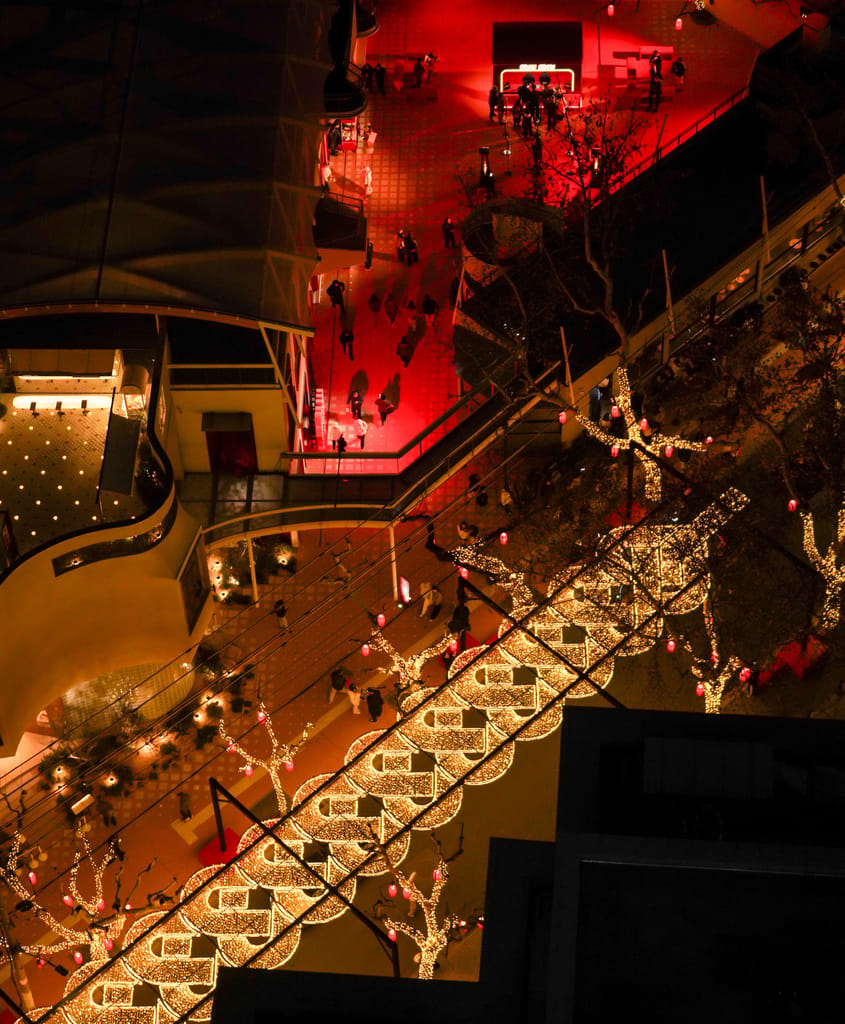
During Chinese New Year, a growing number of young people are taking charge of how the holiday is celebrated.
Two days before New Year’s Eve, posts tagged “Chinese New Year host” began appearing in large numbers on RedNote. Some users shared how they redecorated their family living rooms with muted, minimalist decorations they had chosen themselves. Others took over the reunion dinner menu, replacing traditional shared dishes with Western-style plated courses. Some spent weeks mapping the routes of Minnan deity parades in advance.
Unlike the weary humor that often framed previous years’ homecomings—sometimes described online as “surviving the trip home”—these posts read more like a declaration of agency. If inherited ways of celebrating no longer align with contemporary life, many young people are simply designing a version that does.
Reconnecting through intangible heritage
In many smaller cities, this shift is taking shape through a renewed engagement with traditional culture.
The 2026 Chinese New Year marks the second year since the festival was added to UNESCO’s Intangible Cultural Heritage list. Regional traditions such as Chaoshan Yingge dance, Minnan deity parades, and the Zigong Lantern Festival have moved into a broader national spotlight.
Travel platform Qunar reports that flights to Wuyishan during Chinese New Year rose 1.6 times year-on-year, while ticket bookings for attractions including Kaifeng’s Bian River cruise and Wuhan’s East Lake Plum Garden increased more than fivefold.
Behind these numbers lies a deeper shift in how people experience holidays. In fast-paced urban life, festivals are often reduced to images—moments designed to be photographed, shared, and quickly scrolled past. By contrast, the drumbeats of Yingge dance, the slow movement of deity processions, or the glow of lantern festivals offer something increasingly rare: experiences that require physical presence.
Walking for miles alongside a parade, waiting in the winter cold for a traditional iron-fire performance, or crafting a fish lantern in a workshop—these small acts of participation restore a sense of tangible time. The quiet fatigue that comes with focus becomes, in itself, a brief escape from the rhythms of highly digitized life.
Smaller cities have emerged as important settings for this kind of experience. Unlike the heavily commercialized festive displays common in major metropolitan areas, many local towns still retain a continuity between everyday life and celebration. Chinese New Year there often feels less choreographed and more open.
For many young visitors, spending several days in these places is not simply about changing destinations. It is a way of reclaiming time from the demands of work.
Local governments and tourism operators have moved quickly to respond. Intangible heritage traditions are increasingly translated into experiential offerings—hands-on craft workshops, curated parade routes, and folk-culture merchandise.
These initiatives align with the broader rise of the experience economy while giving traditional crafts a viable place within modern consumption. If smaller cities can sustain high-quality local experiences, the short-lived surge of Chinese New Year tourism may gradually evolve into long-term cultural value.
An airport departure as quiet declaration
At the same time, another group of travelers is choosing to leave.
During this nine-day Chinese New Year holiday—the longest on record—Chinese tourists traveled to nearly a thousand cities worldwide, with visa-free destinations such as Thailand, Malaysia, and Singapore among the most popular.
One notable shift this year is the rise of solo travel. Increasingly, some people are skipping the journey home altogether—boarding international flights before New Year’s Eve or gathering with friends to form temporary holiday households where they live. The expectation of returning home for Chinese New Year is gradually loosening; it is no longer the default choice.
Online jokes about “the first batch of rebellious daughters fleeing overnight” hint at a deeper generational divide. For many younger people, the meaning of reunion is no longer defined solely by distance traveled. It depends on whether relationships feel comfortable and communication flows easily. If the holiday brings social pressure, leaving can become a way of protecting emotional well-being.
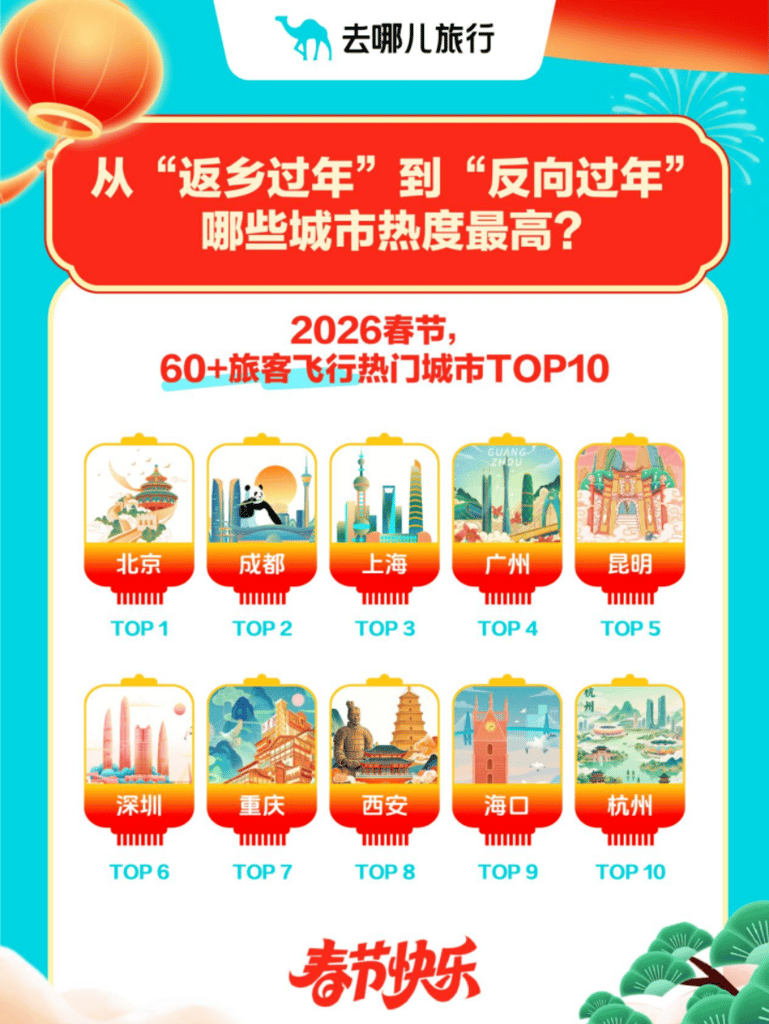
Travel data reflects this shift. Among passengers aged 50 and above, the most popular destinations remain major cities—Beijing, Chengdu, Shanghai, and Guangzhou. Image source: Qunar Travel
Meanwhile, “reverse Chinese New Year travel”—inviting parents to visit instead—has become increasingly common. Many young professionals now bring their parents to the cities where they work and arrange hotel stays for them. Data shows that 18% of passengers flying into first-tier cities during Chinese New Year are aged 50 or above, while hotel stays among travelers over 60 increased by 56% year-on-year.
Families may spend the day dining and sightseeing together, returning to separate accommodations at night. The arrangement preserves the symbolic meaning of reunion while maintaining personal space.
A stability quietly redefined
Whether traveling to smaller cities for cultural immersion or flying abroad alone, these self-appointed Chinese New Year hosts are reshaping how the holiday is lived.
Consumption patterns are shifting accordingly. Spending in smaller cities fuels demand for folk traditions and cultural tours. Those choosing solitude or international travel are more likely to invest in self-care experiences, high-end hotels, or wellness services. Commercial activity no longer gathers around a single set of rituals but disperses across increasingly individualized lifestyles.
For generations, the meaning of Chinese New Year rested on a familiar sequence of rituals: how the reunion dinner should be served, how New Year’s Eve should unfold, what words should be exchanged during holiday visits. Passed down through families, these practices formed a shared script for the festival.
Today, that script is being quietly rewritten.
When reunion becomes a choice rather than an obligation, Chinese New Year as a cultural symbol may actually move closer to lived reality. Intangible heritage, smaller cities, and the decision to leave are not opposing trends but different expressions of the same shift.
Tradition no longer needs to be loudly defended, and individuals no longer feel compelled to justify how they celebrate. Chinese New Year is entering a new phase—looser, more complex, and perhaps closer to how people actually live.